In 1922, a warlord's shells tore through the presidential palace on the south slope of Yuexiu Hill, and Sun Yat-sen's wife barely escaped with her life. Nine years later, on that same scarred ground, the people of Guangzhou and Chinese communities overseas raised the largest memorial hall ever built for the man they call the Father of Modern China. Today the Sun Yat-sen Memorial Hall is one of Guangzhou's most recognisable landmarks: a 71-metre-wide auditorium with not a single interior pillar, a park full of century-old trees, and a genuinely moving record of the revolution that ended imperial China.
This guide covers what the hall actually contains, the history behind it, current 2026 admission and reservation rules (including the passport booking step that trips up a lot of foreign visitors), and how to fold it into a wider day around Yuexiu District.
Quick Facts
A Palace, a Coup, and a Memorial
The Presidential Palace That Stood Here First
The story of this site starts before the memorial hall existed. From 1921 to 1922, Sun Yat-sen governed his rival "Chinese" government from a presidential palace on this exact spot, opposing the Beiyang government in Beijing. On 16 June 1922, the warlord Chen Jiongming turned his guns on the palace. Sun had already left, but his wife Soong Ching-ling was still inside and narrowly survived the shelling and rifle fire before escaping to join Sun on the gunboat Yongfeng, where Chiang Kai-shek later joined them too. The palace was destroyed in the attack.
Building the Memorial, 1929 to 1931
Sun Yat-sen died in Beijing in 1925 without ever seeing his revolution's institutions take permanent shape. Guangzhou's residents, together with overseas Chinese communities who had long funded his cause, decided the ruined palace site should become his memorial. Architect Lu Yanzhi, the same designer behind the Sun Yat-sen Mausoleum in Nanjing, drew up the plans. Construction ran from 1929 to 1931, and what emerged remains, by most measures, the largest memorial hall dedicated to Sun Yat-sen anywhere in the world, larger than its counterparts in Nanjing or Singapore.
The Architecture: No Pillars, No Compromise
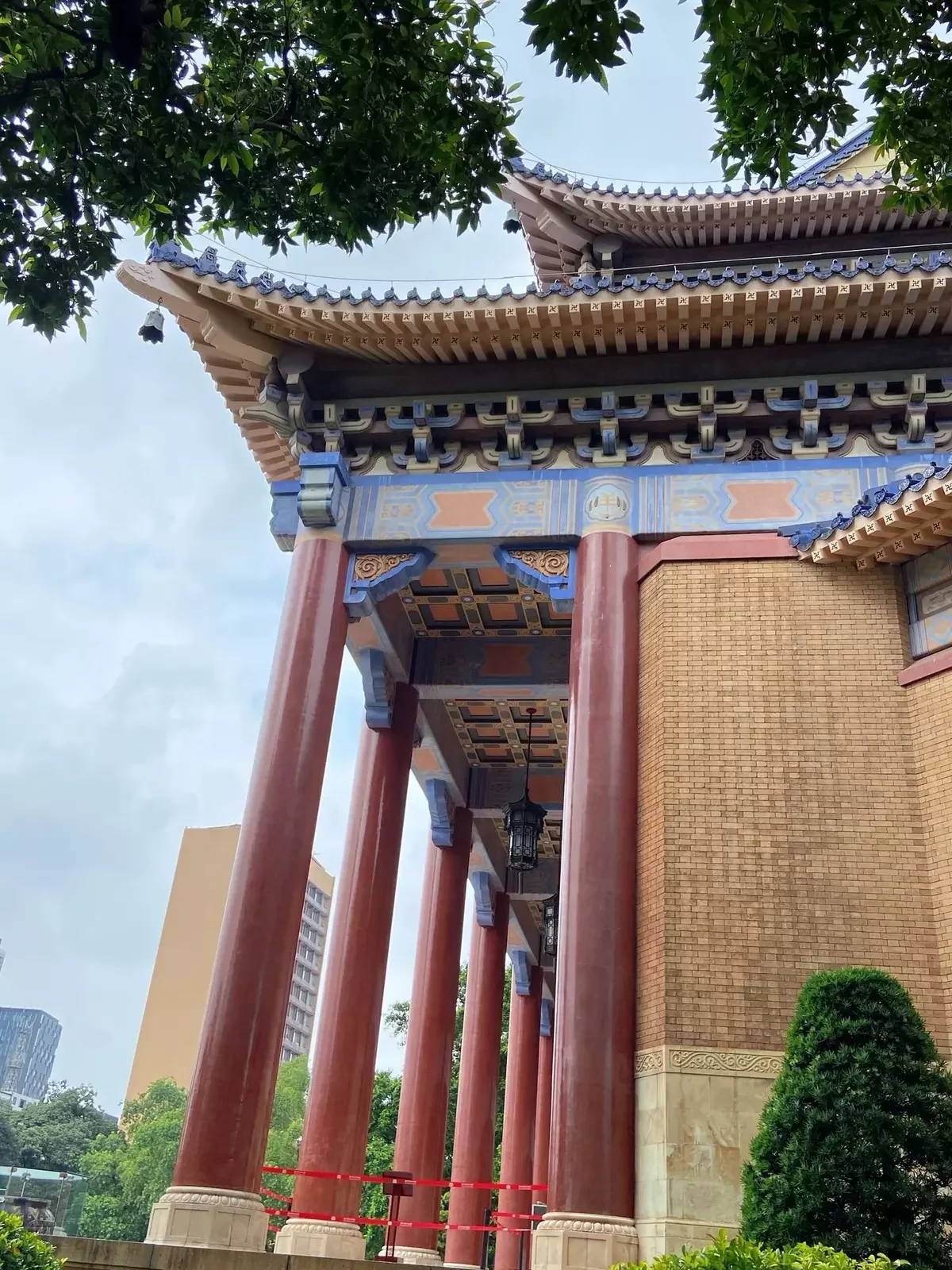
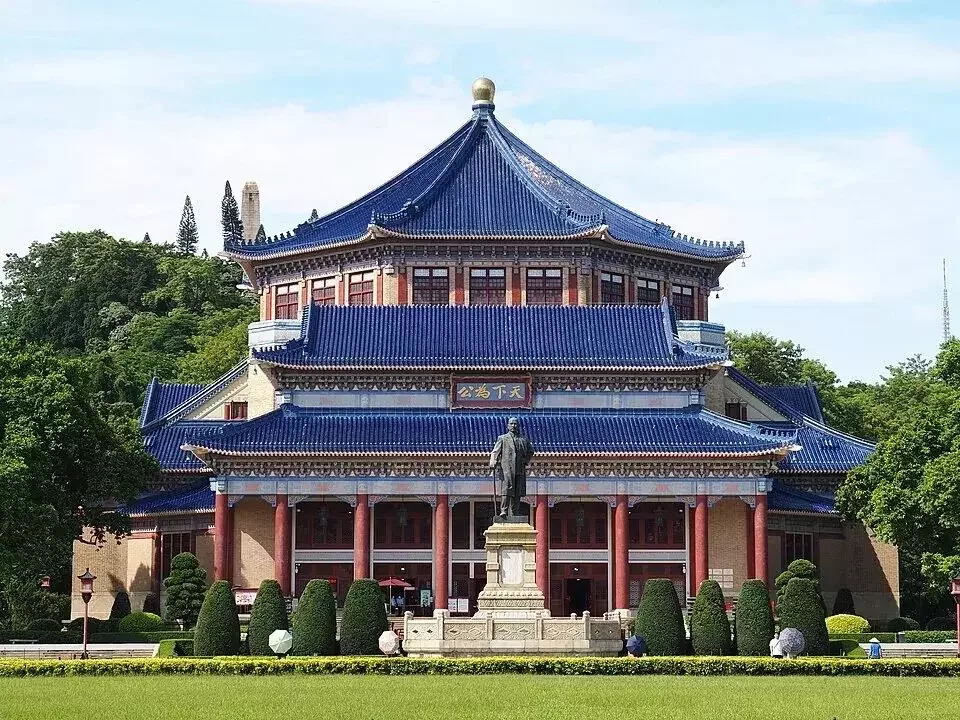
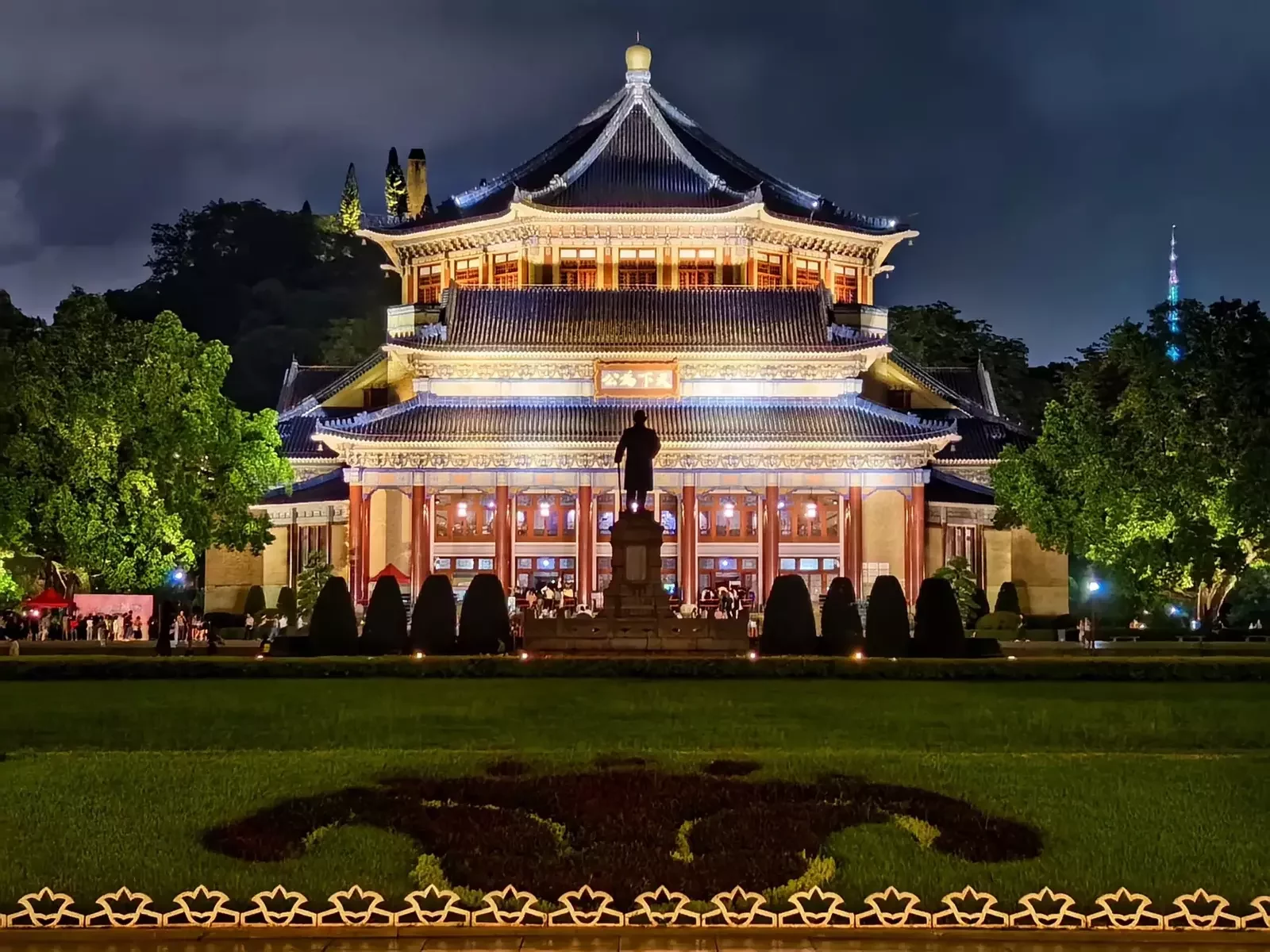
The main hall is an octagon built in the style of a traditional Chinese palace, with double eaves and a gable-and-hip roof finished in the sapphire-blue glazed tiles Sun Yat-sen was known to favour. From the outside it reads as classical Chinese architecture. Step inside and the impression changes completely: the auditorium spans 71 metres with not one supporting column in sight, an engineering feat achieved through a steel truss and reinforced concrete structure hidden entirely behind the traditional facade. Roughly 3,000 to 3,240 seats fit inside, and every one of them has an unobstructed view of the stage.
Hanging at the centre of the hall is a horizontal tablet inscribed with four characters in Sun Yat-sen's own calligraphy: "Tian Xia Wei Gong" (天下为公), roughly "the whole world as one community." It is the closest thing the building has to a mission statement, and it is worth pausing under before moving on.
The Statue and the Exhibition Room
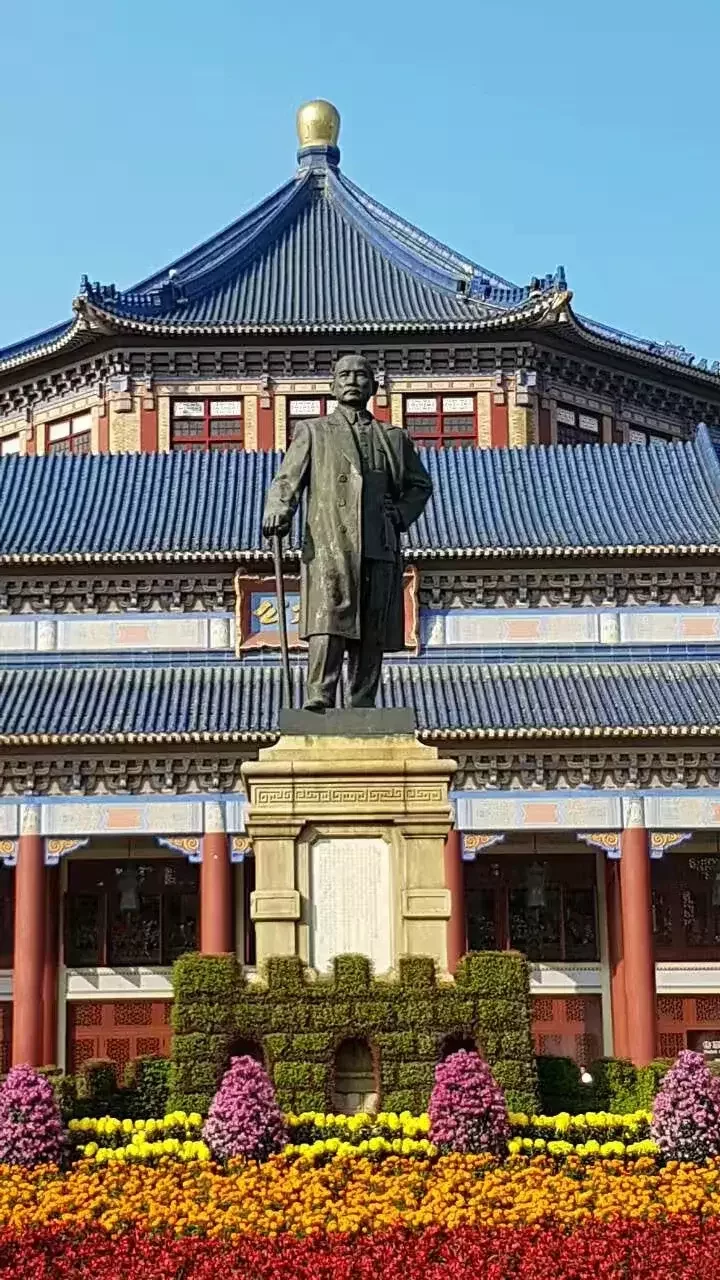
The first thing most visitors see after entering the gate is a 5.5-metre bronze statue of Sun Yat-sen, modelled on his posture while delivering a speech, weighing close to 3.9 tonnes. The base is carved with text from his own Fundamentals of National Reconstruction, his blueprint for China's future.
In the northwestern corner of the main building is the Sun Yat-sen Exhibition Room, a bilingual (Chinese-English) display walking through his life and political career, from his medical training and early revolutionary organising through the fall of the Qing Dynasty in 1911 to his final years. If you want more than architecture out of the visit, this room is where the substance is.
The Trees That Predate the Building
On either side of the hall grow two Michelia alba trees, planted the same year as the building itself and now among the largest specimens of their kind in Guangzhou; they flower in early summer and again in late October. Near the entrance stands an even older kapok tree, over 300 years old and the oldest of its kind in the city, blooming red in early March. Locals treat the whole park, not just the hall, as a genuine green space: mornings bring tai chi groups and badminton games well before the exhibition opens.
Admission, Booking, and What Foreign Visitors Get Wrong
The park itself is free and open from 6:00 AM to 10:00 PM. The main hall, where the exhibition and auditorium are, charges ¥10 for a full ticket and ¥5 for concessions, with free entry for children under 1.1 metres and seniors 65 and older. It is open 9:00 AM to 5:30 PM, with the last ticket sold at 4:45 PM and no entry permitted after closing.
Getting There
The memorial hall has its own metro stop, which tells you how central it is.
- By metro (easiest): Take Line 2 to Sun Yat-sen Memorial Hall Station. The exit leads almost directly into the park, no significant walk required.
- From Guangzhou Baiyun International Airport: About 35 km away; a taxi takes roughly 50 minutes depending on traffic, or take the metro with one change.
- From Guangzhou Railway Station: Around 2.5 km, a short taxi or metro ride.
- By car: The surrounding streets see heavy congestion at peak times; the metro is faster and less stressful than driving in.
Building It Into Your Yuexiu District Day
The memorial hall sits inside a cluster of Guangzhou's most historically dense attractions, all within easy walking or short taxi distance:
Suggested Half-Day Plan
Most visitors comfortably combine the memorial hall, Yuexiu Park, and the Nanyue King Mausoleum Museum into a single half-day, leaving the afternoon free for Shamian Island or the old city's ancestral halls. If you're staying into the evening, Guangzhou's riverside and night market scene is a short taxi away; see our Guangzhou nightlife guide for where to head after dark. For a full breakdown of Guangzhou's neighbourhoods, transport options, and where to base yourself, see our Guangzhou city guide, and for Line 2 and connections across the city, our Guangzhou Metro guide.
Frequently Asked Questions
The park is free and needs no booking. The main hall exhibition benefits from advance reservation, especially on weekends, since same-day capacity can fill up and walk-up entry with a passport is not guaranteed at peak times.
The surrounding park is free. Entering the main building costs ¥10 for a standard adult ticket and ¥5 for concessions such as students and seniors aged 60 to 64. Children under 1.1m and seniors 65 and older enter free.
Most visitors spend 1.5 to 2 hours covering the exhibition room, the main hall interior, the statue, and a walk through the surrounding park.
The Sun Yat-sen Exhibition Room provides bilingual Chinese-English signage and explanations, so English-speaking visitors can follow the main historical narrative without a guide.
Sun Yat-sen Memorial Hall Station on Line 2 sits right at the park entrance, making this one of the easiest major attractions in Guangzhou to reach without a taxi.
Comparable memorials exist at the Sun Yat-sen Mausoleum in Nanjing and the Sun Yat Sen Nanyang Memorial Hall in Singapore, but Guangzhou's hall covers a larger footprint and seats more people than either, a scale tied to its origin as a community and overseas-funded project rather than a state-built tomb.
Visiting Guangzhou for business, not just sightseeing?
If you're in town for the Canton Fair or a factory visit and want a local interpreter, private transport, or help vetting a supplier while you're here, our Guangzhou-based team can help.
Email us